
In 1628, Sweden sent off a brand-new warship built to scare the whole Baltic. With crowds watching from the shore, it sailed about 1,300 meters, leaned over in a breeze, and sank. Almost four hundred years later, it’s the one thing everyone who has been to Stockholm tells you not to miss. So on a Monday when the sky had nothing better to offer, I went to meet it.
It was not the strangest thing I saw that day.
The warship that made it 1,300 meters
Monday in Stockholm was gray.
The day before, I had peeled myself out of bed after an overnight flight to catch a sunset, so I felt I’d done my duty to scenery. A gray day, I decided, has one correct use: give up on pretty photos and take the subway to a museum.
So I headed to Djurgården for a stop every guidebook rates highly: the Vasa Museum.
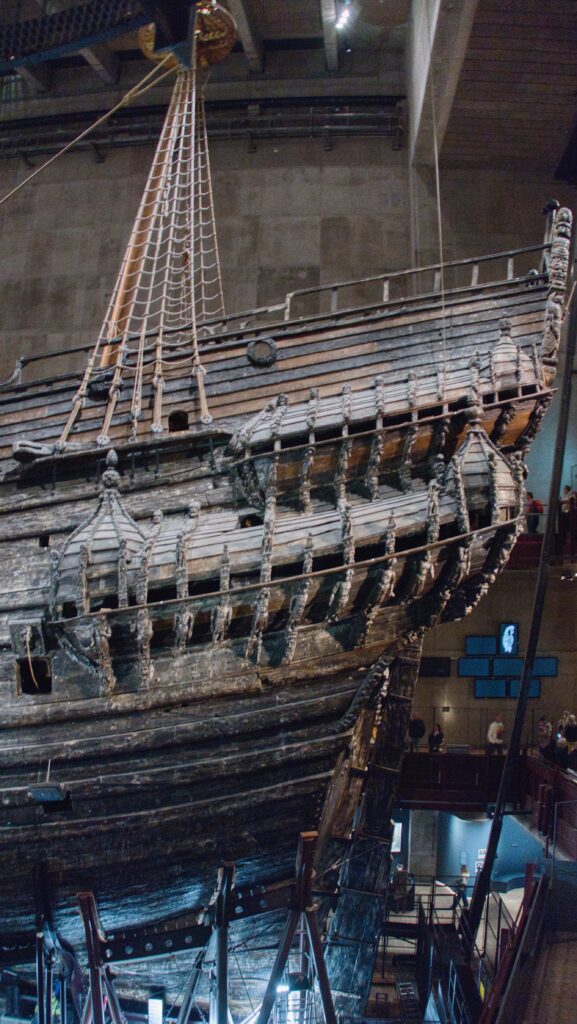
When I asked friends who had been to Stockholm what stuck with them most, a surprising number named this museum. Its star is the Vasa, a Swedish warship that left on its maiden voyage in 1628, made it a short way into Stockholm’s harbor, and sank. It stayed on the bottom for 333 years until it was raised in 1961. The cold, low-salt water of the Baltic doesn’t suit the shipworms that devour wooden wrecks elsewhere, which is the only reason there was anything left to pull up. Today it is the only surviving 17th-century ship in the world.
Sinking on your first day at work is absurd enough on its own.
Inside, the Vasa really is big. It rises several stories, mostly thanks to the masts, and the dark wooden hull is crowded with carvings, gun ports, and decks. It looks like someone moved a wooden building indoors and forgot to tell it.
Honestly, as a modern person, I wasn’t floored by the size. Bigger ships aren’t hard to find today, and the largest reconstructed Viking ship I saw in Norway had plenty of presence too. They are different animals, of course. Viking ships were built to sail fast and raid. The Vasa was a floating gun platform built to show off royal power.
Put it back in the 1600s, parked in the harbor, and I believe it made jaws drop.
But every time I remembered it sank on its first outing, the reverence drained right out of me. This is no battle-scarred legend that came home in triumph. It is a giant engineering project that tried too hard and failed before its first shift. Standing in front of it, you’re looking at the ambition of an era and the physical evidence of that ambition tipping over.
I didn’t study every panel. What turned the Vasa from a big failed warship into a ship people had lived on was a private English-language tour I latched onto. The guide wasn’t mine, but he wasn’t whispering either, so I drifted nearby and listened in.
That’s how I learned that archaeologists worked out how the crew lived from the skeletons found on board. One belonged to a short man with clear signs of osteoporosis. His teeth were wrong too, something like a second row growing in (I was eavesdropping, so don’t quote me on the dental details). A modern dentist could sort that out. In 1628 it meant chewing hurt, so he lived on porridge.
The guide also pointed out the class divide. One roomy cabin had benches along the walls that pulled out into something close to a king-size bed. That space was for senior officers, and for the king himself if he ever came aboard. The gun crews got no such luxury. They worked and rested in shifts, and when it was their turn to sleep, they lay down next to the cannons.
So at one end of the ship you had something like a palace bedroom, and at the other a crowded deck where men took turns napping beside the guns. The Vasa never fired a shot in battle, but it had already packed the entire 17th-century class system into its hull.
At full strength, it was designed to carry 133 sailors and 300 soldiers. Senior officers lived in the stern cabins, with more space, windows, and furniture. Everyone else ate, slept, and rotated between the guns.
The museum also has a small cinema that tells the Vasa’s story in several languages. I’d missed the English showing and was about to give up when I saw the next one was in Chinese.
It turned out to be the part of the museum I paid the most attention to.
On the day of the maiden voyage, every gun port was open, partly to fire a salute and partly to show off the new ship’s firepower. Not long after leaving, a gust pushed the ship over to one side, and water poured in through the open lower gun ports. It had sailed about 1,300 meters, for roughly twenty minutes, before it went down.
My first thought when the film ended: this is obviously a design problem.
The Swedish crown did hold an inquiry. They questioned the captain, the officers, and the builders, checked the ballast, and asked whether the guns had been properly secured. In the end, nobody was punished. The official explanation is that the ship’s center of gravity was too high and its hull too narrow, so a breeze was enough to tip it. The open gun ports let the water in, but they weren’t the reason it tipped so easily.
My favorite detail, and one I wish I’d invented: before the voyage, the ship had a stability test. Thirty sailors ran back and forth across the deck. After three laps the Vasa was rolling so badly that the admiral called it off. Then they sent it out anyway.
I had wondered who signed off on a design that tips over in a breeze. Did the designer have such powerful connections that the king didn’t dare go after him?
The answer is less dramatic. The master shipwright, Henrik Hybertsson, had died more than a year before the Vasa sank. During the inquiry, the builders insisted they had built the ship to dimensions the king approved. The official timeline points to Hybertsson’s poor proportions, but he was in no position to defend himself, or to be punished.
Convenient.
None of this makes the ship any more sensible. The Vasa still looks like a mega-project driven by royal ambition that outran the technology of its day. Everyone wanted a taller hull, more cannons, and a scarier silhouette, and nobody gave it a body stable enough to carry all of that.
In software terms, this wasn’t a drunk operator pressing the wrong button. Requirements kept piling up, nobody admitted the system had limits, and the original architect was no longer around to take the blame. I have sat in that sprint planning.
I went in a little before eleven, circled the ship and the galleries, collected a lot of shipboard gossip from a tour that wasn’t mine, and at 12:20 caught the Chinese film and, unusually for me, listened to the whole sinking story from start to finish. When it ended, it was lunchtime.
Shrimp on a waffle
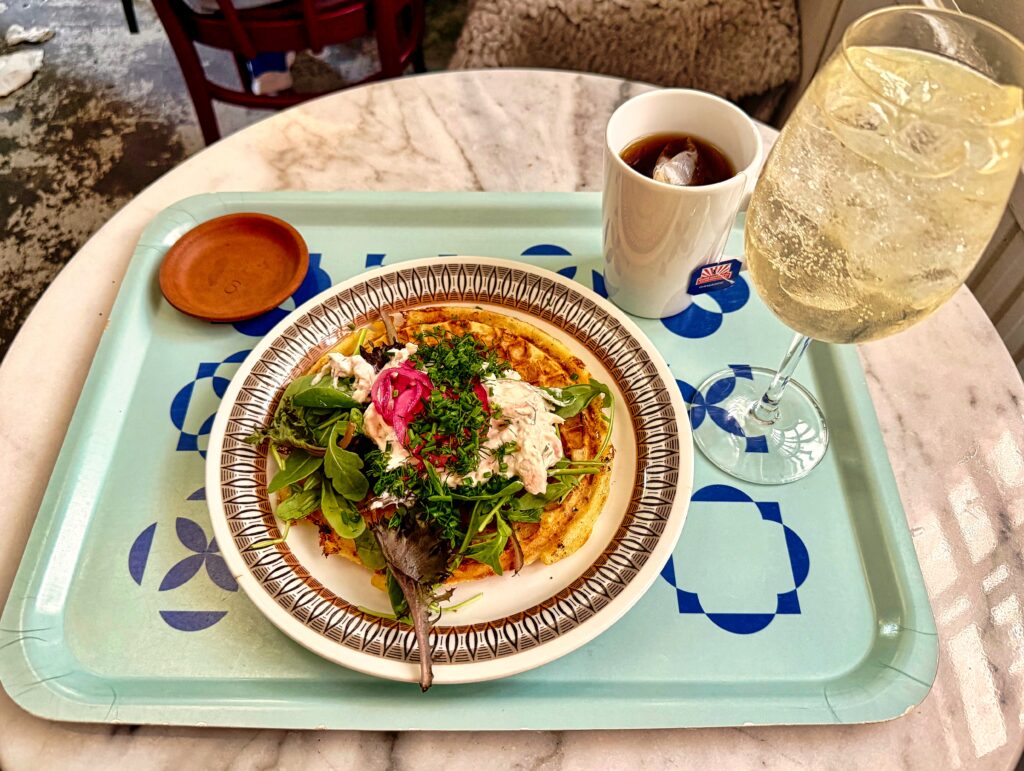
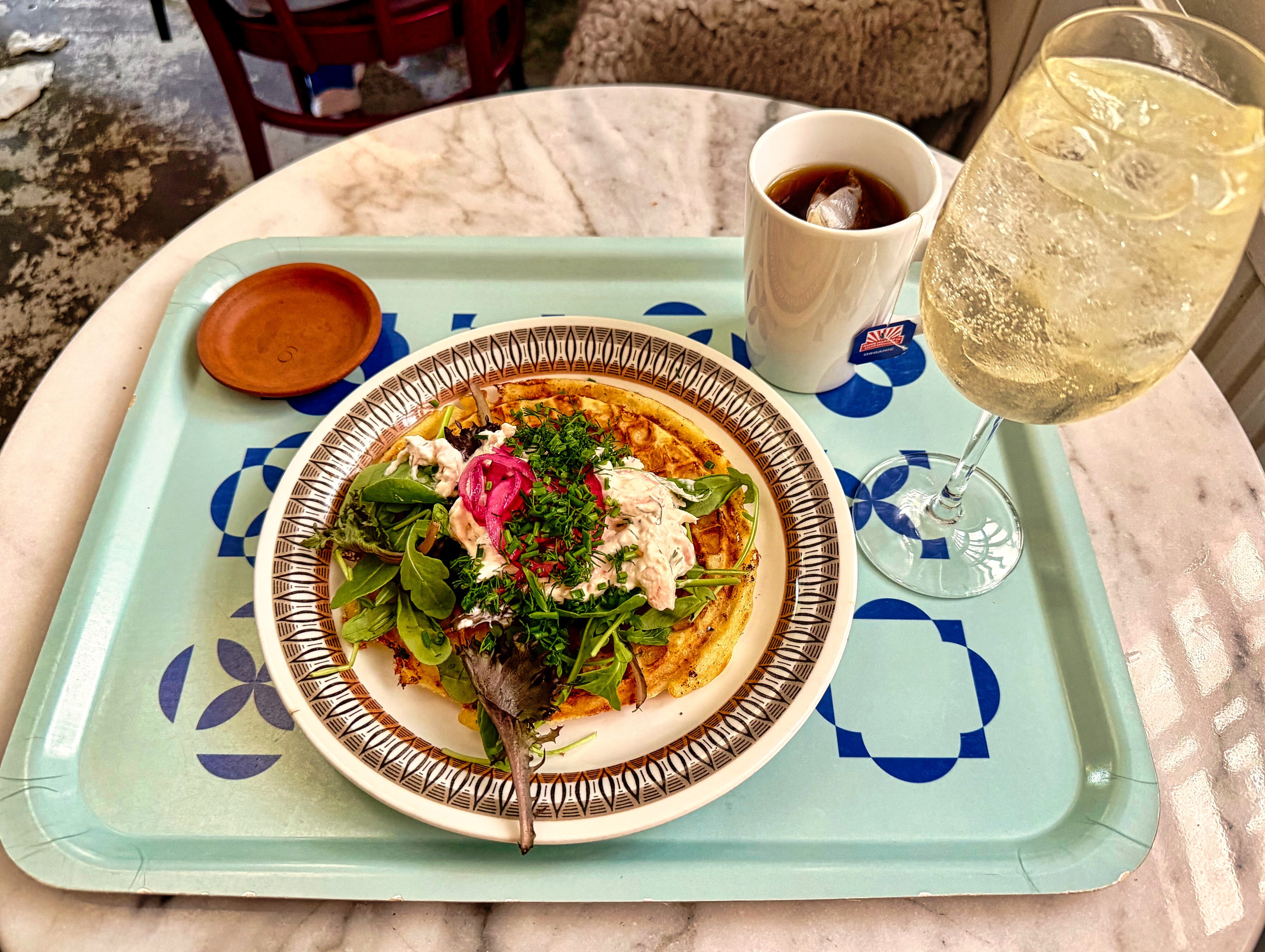
Instead of going back for more panels, I walked next door to the café outside the Nordic Museum and ordered the Lusknappen Skagen Waffle. That is a waffle with shrimp on it.
Ordering it, I was mostly confused. In my head, a waffle is sweet. It comes with cream, syrup, or fruit. Who looked at that and thought, shrimp?
I braced myself for a culinary disaster.
It was delicious. The waffle itself isn’t sweet at all, and with the shrimp and Skagen sauce on top it made complete sense. Skagen is a Swedish classic of shrimp, mayonnaise, and dill, dreamed up in the 1950s by the restaurateur Tore Wretman and named after a fishing town in Denmark. The crisp waffle and the cold, briny shrimp got along perfectly, with none of the weirdness I’d prepared for.
So on day two in Stockholm I saw a giant warship that sank on its maiden voyage, then ate a shrimp waffle. The first taught me that 17th-century engineering projects should not be so sure of themselves. The second taught me not to be so sure of myself about unfamiliar food.
The museum next door ate my afternoon
After lunch it was still gray. The Nordic Museum is right next door, and it had made it into my plans for one reason: it was close.
I assumed it would be a quick lap through Swedish folk life and history. That “quick stop” swallowed my entire afternoon.
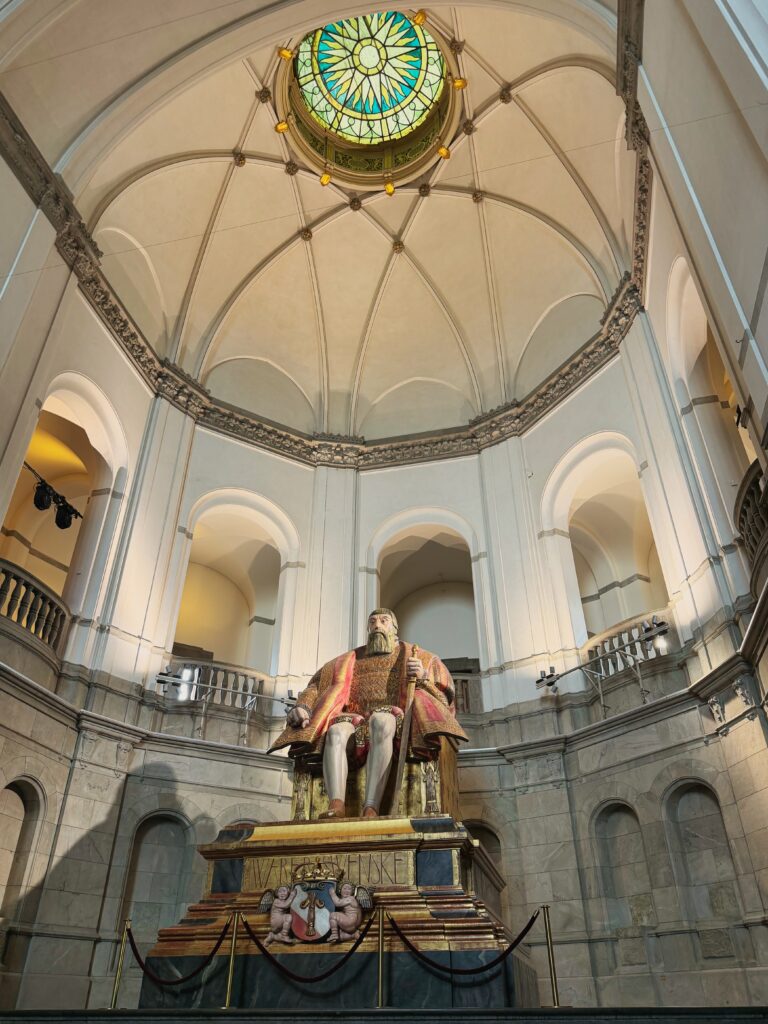
The building alone should have warned me. From the outside it looks like a Renaissance castle, and inside it opens into an enormous, mostly empty great hall with one giant statue in the middle. (It’s Gustav Vasa, the 16th-century king who founded modern Sweden, whose family name ended up on the unlucky warship next door.) The scale was far bigger than I expected, and for a moment I had no idea where to start. On one side of the hall was an exhibition about melting glaciers, and I almost walked straight in. But the arrows on the floor were very firm about it: take the elevator to the top floor and start there.
So I did what the arrows said.
Looking back, this was the Nordic Museum’s first trap. It starts you at the top and lets you work your way down, floor by floor, until your legs stop cooperating and you realize you still aren’t done.
The permanent exhibition isn’t divided by theme (clothing, food, holidays, furniture). It runs in chronological order. Starting from the earliest period, it walks you through daily life century by century: what people wore, where they lived, what they kept at home, what tools they used, how they ate, and how all that ordinary stuff ended up in glass cases.
At first this feels very friendly. You don’t need to understand the whole sweep of Swedish cultural history. You just follow the timeline.
The problem is that once you’re on it, it’s very hard to get off.
Finish one century and you want the next. When did the clothes change? When did furniture stop weighing as much as a small car? When did an ordinary household start owning things I’d recognize?
I had come in to “learn a little Swedish history.” Soon the timeline was dragging me down one floor and one century at a time.
The museum has been collecting Swedes’ belongings and stories since 1873, covering the 16th century to today. It doesn’t only keep the history of royals and famous people. It also holds a huge amount about how ordinary people lived. So when the exhibits are laid out as a timeline across several hundred years, you see more than date labels. You see daily life being slowly rewritten, generation by generation.
One series of displays shows dining tables from different eras. These aren’t little family tables. They are long banquet tables set for aristocratic dinners, crammed with silver, cutlery, plates, glasses, and ornaments, as if the host might walk in with a crowd of guests at any moment.
The one I remember best is the earliest.
There was a swan on it.
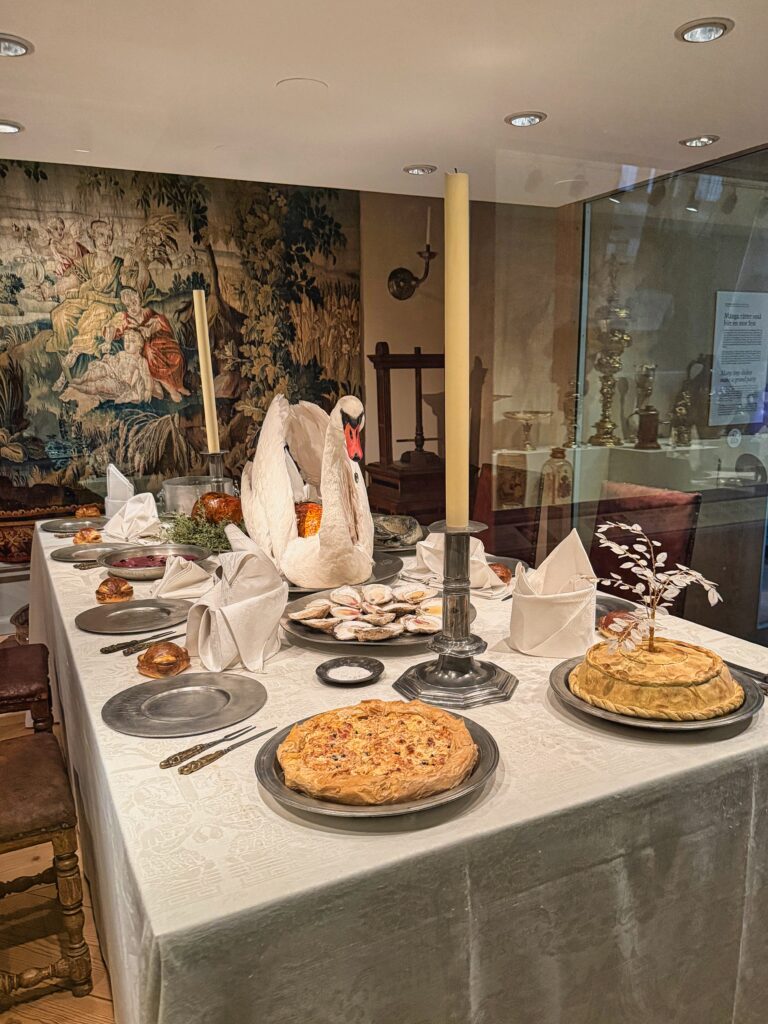
I assumed it was decoration. Then the audio guide explained that people used to serve meat inside the swan. The point clearly wasn’t the food. The point was to tell every guest: we can afford meat, and we also have an entire swan to serve it in.
The audio guide then added, with admirable restraint, that this was not very hygienic.
No kidding. If that swan was being refilled, carried out, and shown off over and over, hygiene was not on the menu.
As the tables move forward in time, the food slowly becomes normal. The early tables seem to be about one thing: making sure everyone can see how rich you are. Long tables, meat, silver, and a swan you can stuff meat into. Closer to the present, the silver gives way to porcelain, and the food stops looking like a spectacle and starts looking like something I’d recognize and want to eat.
By the end, the scene isn’t a formal dinner anymore. It’s more like a tea party spread with little snacks. It’s still social, with hosts and guests and rules and a bit of showing off, but the mood has gone from “behold, I can serve you an entire bird” to “come sit down, have something to eat.”
At least judging by the galleries, it took the Swedish dinner table several centuries to get from an aristocratic stage set to something like the living rooms we know.
Following the timeline down, the picture of Swedish history I came away with was surprisingly simple.
The earliest Nordic people were busy surviving the cold with limited resources. As their numbers, trade, seafaring skills, and contact with the outside world grew, they started heading out. The exhibition mentioned their trips south and west, and one wonderfully human detail stuck with me: when they reached England, they were impressed by how nice the weather in London was.
Standing in Stockholm, I completely understand. If you come from somewhere cold enough to make you sail off and explore, a place with mild weather is going to look very tempting. Think about that for a second: London, praised for its weather.
The “they” here shouldn’t be confused with the later Swedish state, of course. Vikings came from what is now Denmark, Norway, and Sweden, and their raids and settlements in England don’t add up to “Sweden once took London.”
Still, the impression the exhibition left was vivid. The Nordic countries haven’t always been quiet, neutral places that design furniture and take fika breaks. They have a long history of heading out and fighting over land and influence. Vikings invaded England in the 9th century, and in the 17th century Sweden became a European great power controlling much of the Baltic. That second chapter is the era of the Vasa, which is to say the empire was building warships to match its ambitions, and at least one of them didn’t make it out of the harbor.
In the modern section, the exhibition gets to the current royal family. The bit I remember most is about Crown Princess Victoria, who married her former personal trainer, Daniel Westling.
I have no idea how much royal protocol went into that decision, but “the princess married her gym trainer” is a lot more down-to-earth than what I imagined European royal life to be. He became Prince Daniel, rather than arriving as one of those fairy-tale nobles whose pedigree matched perfectly from the start.
When I finally made it from the top floor back to the ground floor, I was back where I started, at the glacier exhibition by the entrance.
As far as I could tell, it was about how retreating glaciers affect ecosystems and the dangers of global warming. These things matter, and in theory they deserve my full attention.
In theory.
By then I had seen a sunken warship, eaten a shrimp waffle, and walked through several hundred years of Swedish daily life, one century per room. My legs were close to going on strike.
So my takeaway from the glacier exhibition is correct but very general: melting glaciers are bad for ecosystems, and global warming is dangerous. The finer details I leave to people with more energy, or at least to people who didn’t do two big museums in one day.
I only added the Nordic Museum because it was next to the Vasa. I walked in expecting a museum you pop into on the way past and walked out of a giant time machine that lays several hundred years of Swedish everyday life out for you to walk through.
I didn’t memorize every era, and I couldn’t explain Swedish history if you paid me. But I did learn one thing: if anyone tells you the Nordic Museum is just the place next to the Vasa that you “might as well see,” don’t believe them.
Give it a whole afternoon.
Just check with your legs first.
Dinner, courtesy of a credit card
After the Nordic Museum, I went back to Hotel At Six for a rest. Two big museums in one day, and even I couldn’t keep pretending a little more walking would be fine. My legs needed some time not moving.
At six, I had dinner downstairs at Brasserie At Six.
The reason I picked it was purely practical. Booking the hotel through Amex Platinum came with a $100 dining credit.
Free money is free money.
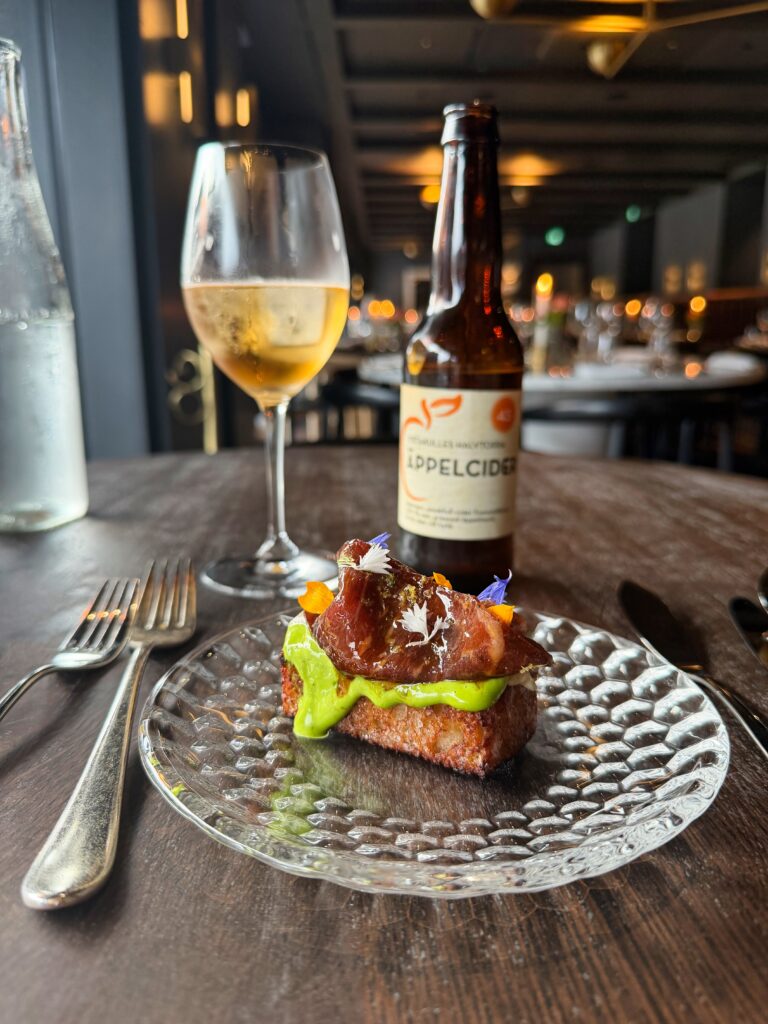
I ordered the Herring Boquerones, the Dry-aged Raw Beef, and the Seabass Grilled on Skin, with a glass of Vistakulles cider. For dessert I had the Raspberry: almond cake, meadowsweet mousse, raspberry sorbet, and meringue.
Swedish herring lives up to its reputation. It was excellent. After an afternoon of staring at historic dinner tables, eating pickled herring at a real one felt like walking out of the museum and back into the present.
The dry-aged raw beef tasted good, but the “raw beef” part still made me a little nervous, so I didn’t finish it. Thinking about it rationally, I had already eaten most of it, so leaving the last bite didn’t accomplish anything.
The sea bass was solid, and the raspberry dessert was lovely. The plating and the flavors were good across the board, and after a sunken ship, centuries of Swedish domestic life, and a melting glacier, my final feeling was very simple:
I was stuffed.
That morning I had seen where the Vasa’s gun crews slept, right next to the cannons. That night I ate a four-course dinner on a credit card perk and went upstairs to an actual bed.
History did not teach me how to use an Amex Platinum. But when you’ve walked until your legs nearly give out, sitting down to a good meal without wincing at the bill is its own kind of modern civilization.