At 10 a.m. on a Tuesday, I boarded a two-hour archipelago cruise from Stockholm’s Old Town.
It seemed like the obvious thing to do. Stockholm is a city stitched together from waterways, islands and bridges, and I had spent the previous two days seeing it from dry land: the Old Town, a sunset, and the Vasa, a warship that sat at the bottom of the harbor for more than 300 years. Leaving without getting on a boat at least once felt wrong.
I booked the cruise on GetYourGuide, and the itinerary was gorgeous on paper. Fotografiska, the Djurgården Canal, Fjäderholmarna, Stora Höggarn, Tegelön, and even a run toward Vaxholm.
When I boarded, the sky was only gray. Overcast skies make for flat photos, I knew that. But surely the sea would have a moody charm of its own. Besides, I had already paid, and you don’t run away from a tour just because the sky looks unenthusiastic.
The boat pulled away from the dock, and it started to rain.
Then it rained harder.
Morning: the archipelago, in theory
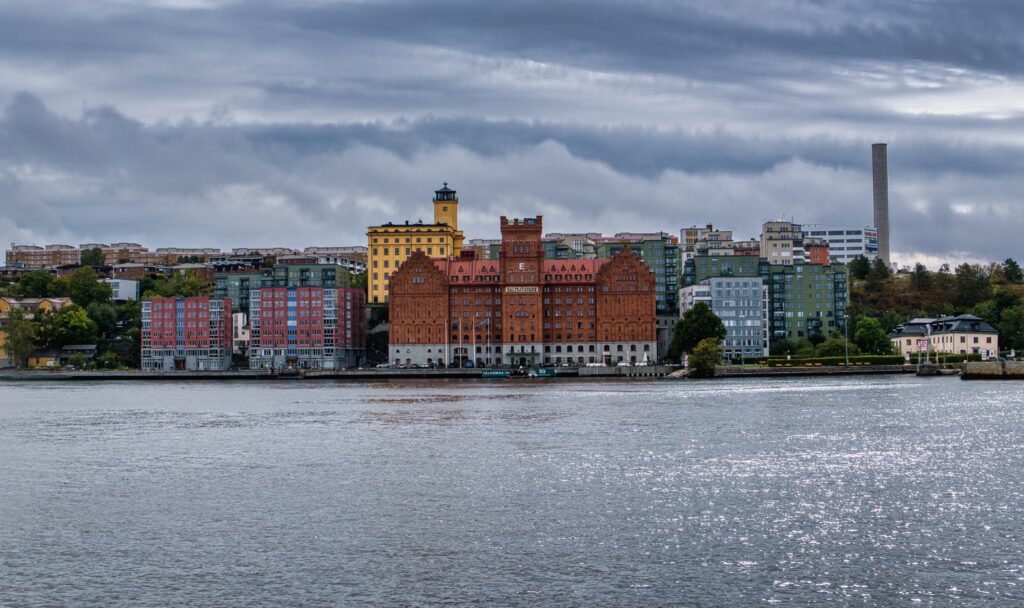
The best part of the cruise turned out to be the beginning, while we were still close to town and could make out the buildings, the docks, and the islands behind them. When Fotografiska came into view, I had a sudden thought: maybe I should visit this famous photography museum after all.
We also passed the spot where the Vasa went down.
The day before, I had stood in the Vasa Museum staring up at this enormous warship, wondering how it managed to capsize on its maiden voyage. From the cruise, I could finally answer a different question: how far did it get?
Not far.
The Vasa set off near the Royal Palace, sailed about 1,300 meters, and sank inside Stockholm’s harbor after roughly twenty minutes. It’s hard not to picture the crowd in 1628, standing on the shore close by, watching a brand-new warship fire its cannons to show off its power, then tip over in a gust of wind and vanish. The Vasa never met a storm on the open sea. It proved it couldn’t sail before it had technically left town, in full view of everyone.
The weather was bad, but the commentary was good. Our guide was a live human, not a looped recording, and she talked about whatever the cruise passed.
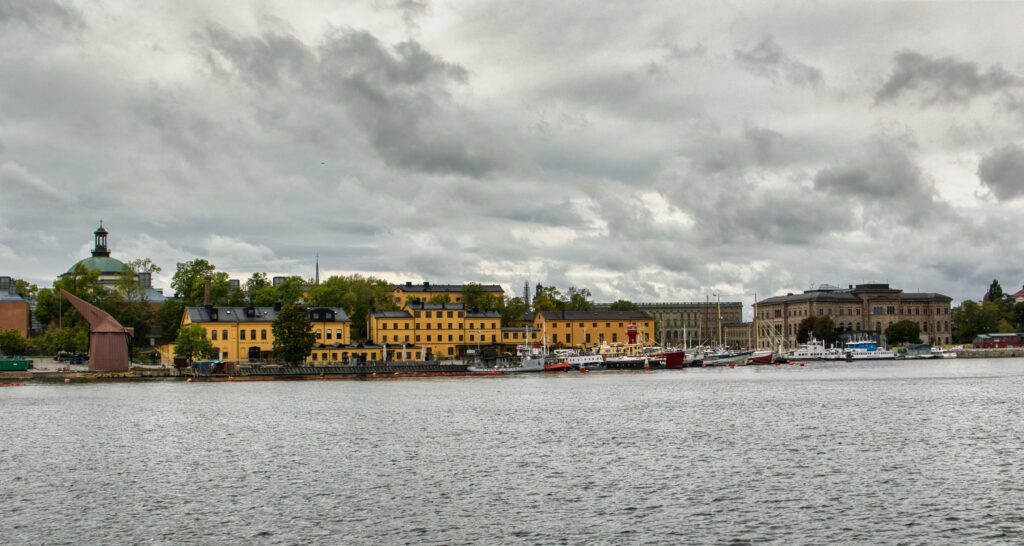
Further out, houses began to appear on islands that clearly had no road to the city. For the people living there, a boat is not a toy for a weekend spin. It’s how you leave home, come back, visit the next island over, and go on vacation. The archipelago is commonly said to have about 30,000 islands, skerries and rocks, and ferries are one of the most common ways to get around. What was “a boat ride to look at the sea” for me is, for locals, just how life works.
Many of those houses were painted the same deep, brownish red. I think I’d heard about the color at the Nordic Museum the day before, but it only clicked when I saw row after row of it from the boat. It’s called Falu red, a byproduct of the copper mine in Falun: iron-rich mine residue turned into pigment, then mixed with rye flour and linseed oil into a paint that helps wooden walls survive Nordic wind and rain. I had filed it under “very Scandinavian color.” It turns out to be mining waste with a second career in weatherproofing.
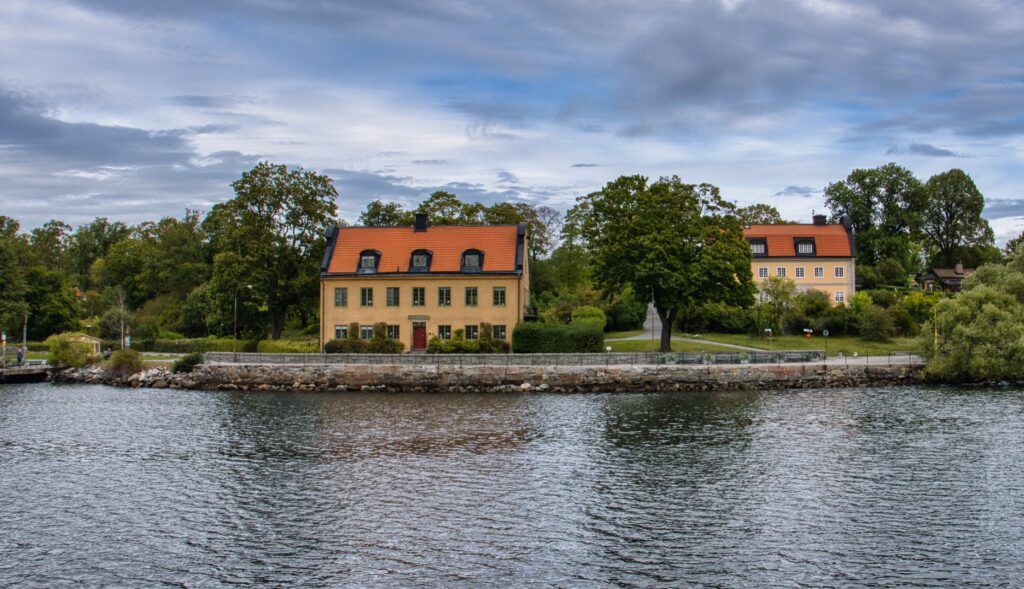
Before I could get any good shots of it, the rain got heavier.
It was only early September, but between the rain and the wind off the sea, this was well beyond “Nordic summers are a bit cool.” The other tourists were committed, though. Even in the worst of the downpour, plenty of people stayed on the open top deck. I stuck it out with them for a while, as if sitting outside long enough would make the clouds part on cue.
Reality was not that inspirational.
Eventually I went downstairs. I still wanted to see everything. I just realized that “taking a cruise” did not have to mean “catching a cold on purpose.”
We turned back before reaching Vaxholm, probably because of the weather. That string of island names on the itinerary became a wish list for a sunnier day. The rain did teach me one thing: Swedish summer really is June through August, and by early September you get cold wind and rain.
My phone photos were close to useless, one gray-white smear of lens, window, water and distant islands. Luckily, I had brought my Leica D-LUX 8, which can shoot five frames in a row, each 1 EV apart. At home I merged them with HDR Merge in Luminar Neo and rescued a few. They are not the blue-sky archipelago shots I had imagined, but they kept some of the red houses, the water and the clouds.
Some travel photos are worth keeping because they take you straight back to a moment: sitting on the top deck in the sea wind, knowing full well it’s raining, and refusing to go inside just yet.
Afternoon: an art gallery that happens to run trains
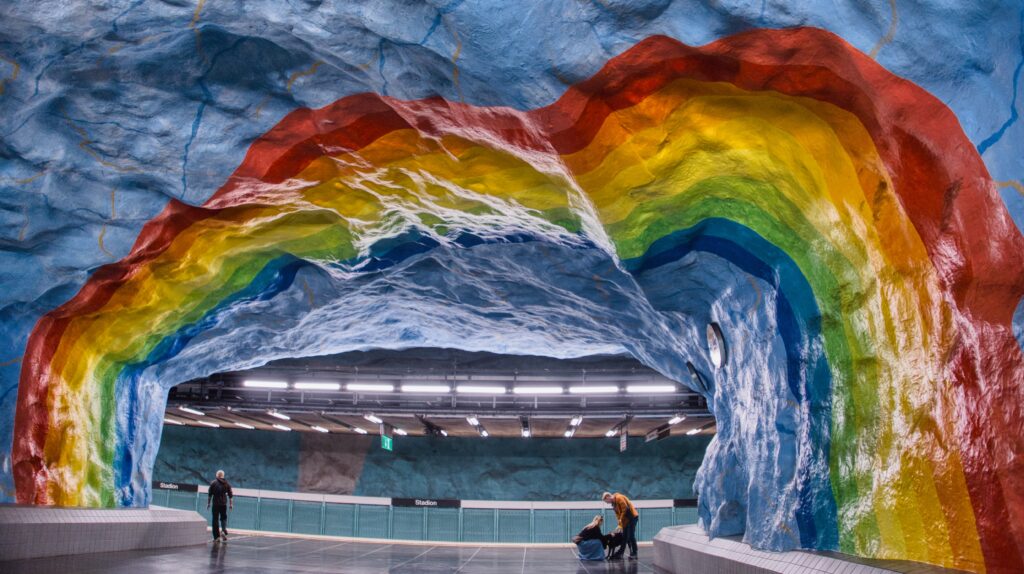
At 3:30 p.m., I joined a Stockholm subway art tour.
The morning cruise had been a standardized itinerary: a few islands, a few place names, two hours on the water. The afternoon felt more like someone leading a group of strangers underground and teaching them to look again at a city they would normally just commute through.
Kungsträdgården
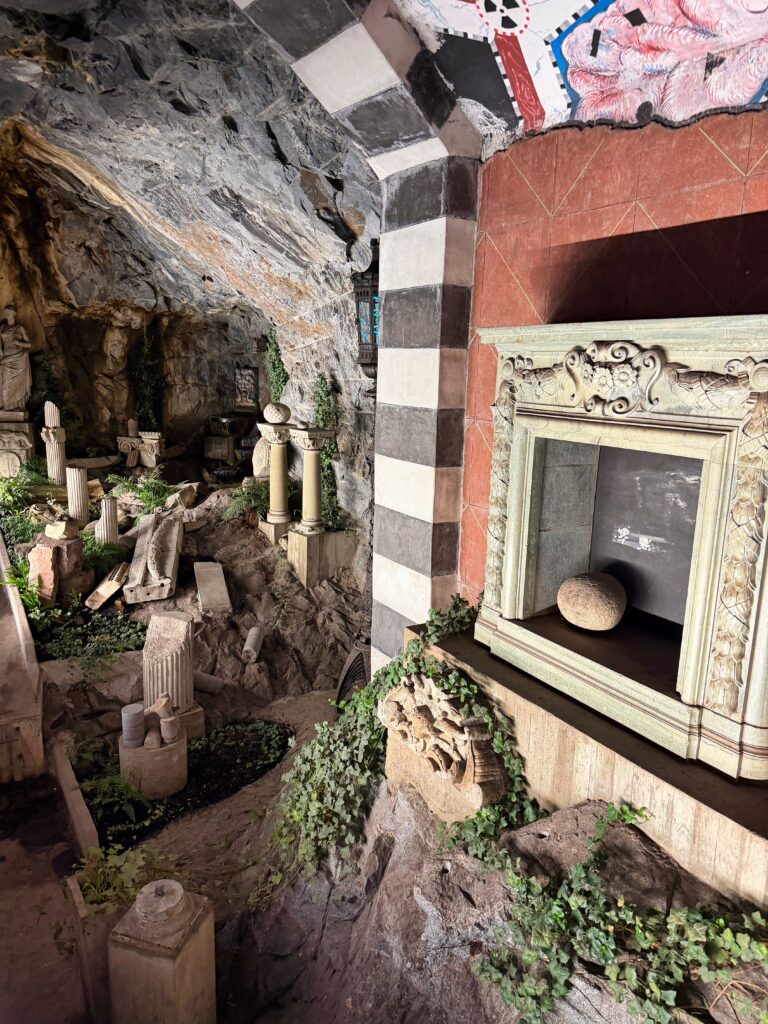
I had been through this station before without noticing any art. To me it was a place to get off, follow Google Maps to an exit, and hurry to the next sight.
This time, the first thing I noticed was a row of piano keys above the escalator. No explanation needed. You look up and an ordinary escalator has turned into an instrument hanging underground.
Before you reach the platform, statues stand guard along the way. You won’t notice them if you are in a hurry though, as they are below the passageway and you will have to look down on the sides to see. The originals are from the 1600s and sit on the roof of the House of Nobility, about 30 meters above the ground. The artist brought copies down about 30 meters below it. They look a little chubby and squashed, which seems fair when you’re holding up that much rock.
The best story belonged to an unremarkable-looking tree stump.
In 1971, the city planned to cut down 13 old elms in the park above to build a new station exit. People climbed into the trees or stood beside them to stop the felling, crowds gathered, and the police eventually withdrew. The exit went somewhere else. The stone stump, saw marks and all, remembers what became known as the “Battle of the Elms.”
So an underground station keeps the stump of a tree that never existed, in honor of the real trees above that never got cut. I love this. There’s no solemn plaque. You’re on your way to catch a train and you run into the time the city refused to build what it had planned.
The funniest detail was the electronic dripping-water sound at both ends of the platform. The guide said it’s there to remind you that the line runs below sea level.
My first reaction was not “how poetic.” It was “New York.” When it rains, the New York subway leaks for real. No sound effects required.
Stockholm turns dripping water into public art. New York lets passengers confirm in person, by getting dripped on, that the ceiling is leaking. Both subways have a relationship with water. They just handle it very differently.
T-Centralen
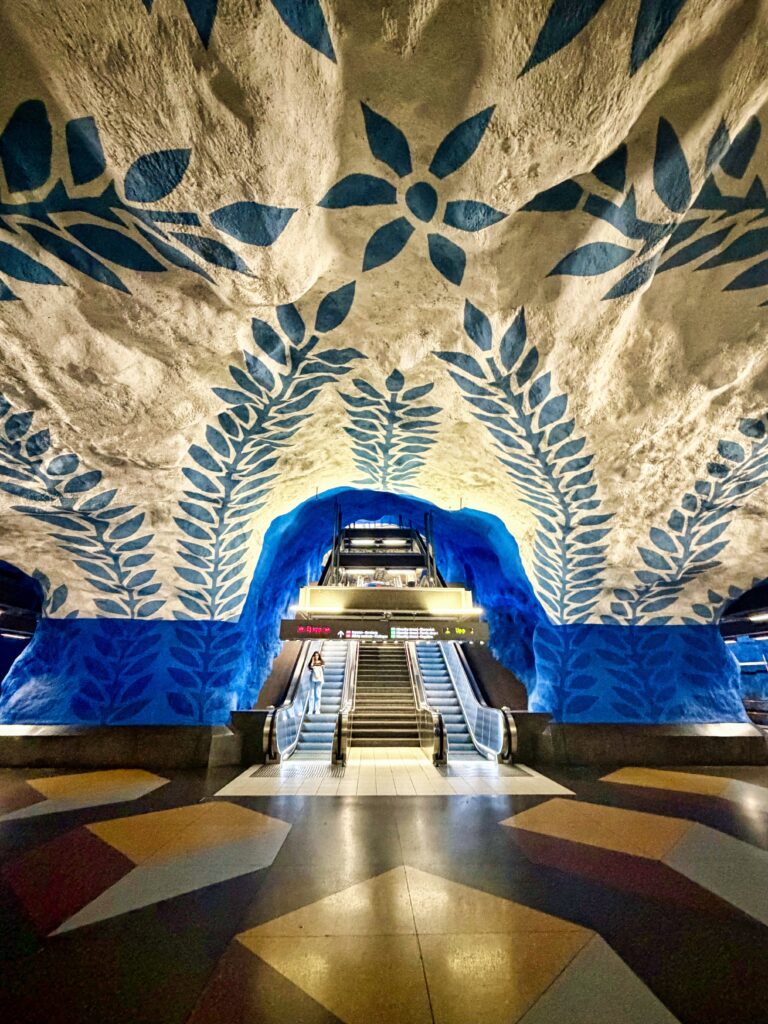
The central station ought to be the easiest place in the system to ignore. It’s the city’s main transfer hub, full of people dragging luggage, switching lines and checking when the next train comes.
The blue line platform barely gives you the option.
The cave-like walls and vaulted ceiling are painted white, with huge blue vines, leaves and flowers creeping across the rock. It feels like walking inside an upside-down porcelain bowl, or an ice cave someone relocated underground. Even with trains pulling in and escalators hauling passengers up and down, it photographs beautifully.
The guide said the artist, Per Olof Ultvedt, chose blue partly to calm people down in a busy, stressful station. That feels very Nordic. Another city would make its busiest station brighter, plaster it with ads and turn it into a machine that hurries you along. Stockholm painted it with blue-and-white plants and asked you to take a breath first.
Whether that works depends on your day. If you’ve just missed a train, you’re dragging a suitcase and you still have three lines to change, no number of blue vines will put you in a meditative state.
As a tourist, I had no train to catch. So I stood on the platform taking photos, pretending this was a gallery that trains are allowed to pass through.
Rådhuset
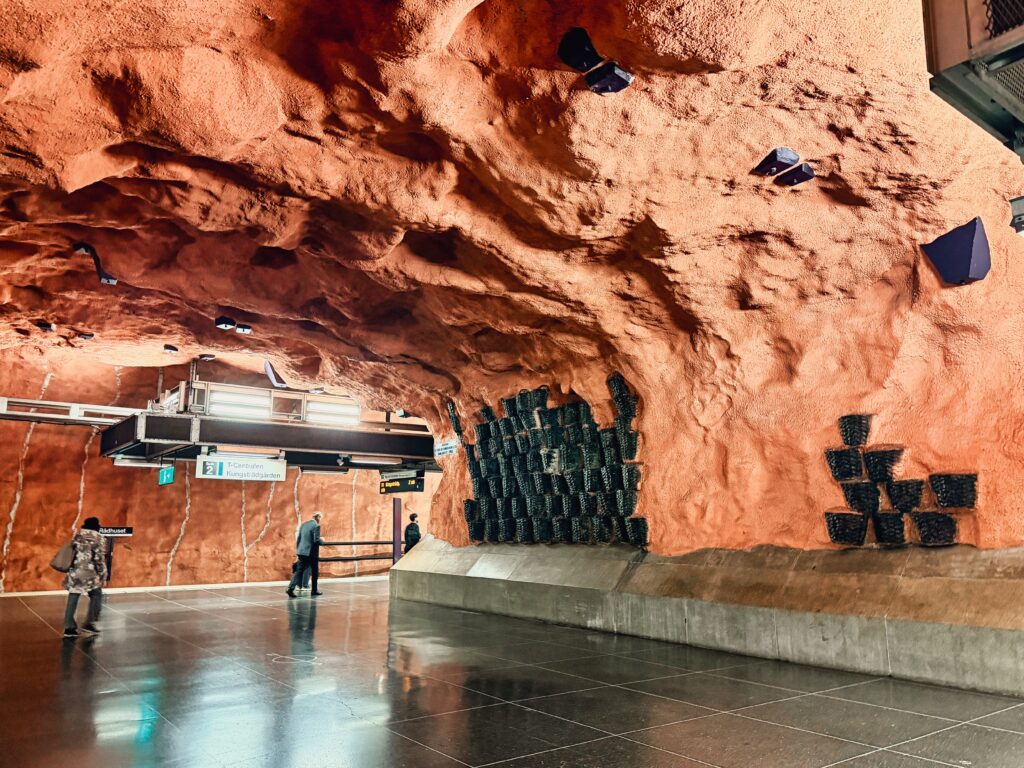
I had seen this one on YouTube. In the videos, the red-brown rock walls and cave-like vaults look like a movie set: perfect light, nobody around, every screenshot a tourism ad.
My photos never came out like that.
Some stations have tons of atmosphere in person but don’t hand everyone the same YouTube-perfect shot. The red walls are striking, but light, angles, trains and crowds all crowd the frame.
What Rådhuset gave me instead was its odd little pieces of old Kungsholmen life, tucked into the rock like a local history museum. Set into the platform wall is a huge black wooden box. I took it for a crate of market goods. It’s a parm, a wooden measure once used for hay. There are baskets too, a nod to the markets that once filled the neighborhood, when baskets were the standard shopping bag.
The strangest detail is overhead: two boots hanging from the ceiling. I assumed they honored workers, since a pair of upside-down boots in a cave looks a lot like a labor history installation.
Wrong. The little sign next to them reads “Lyckans galoscher från Hantverkargatan,” the lucky galoshes from Hantverkargatan, the old craftsmen’s street right above the station. Both boots are left feet. Lucky, maybe. Not the street’s finest shoemaker.
Tekniska högskolan
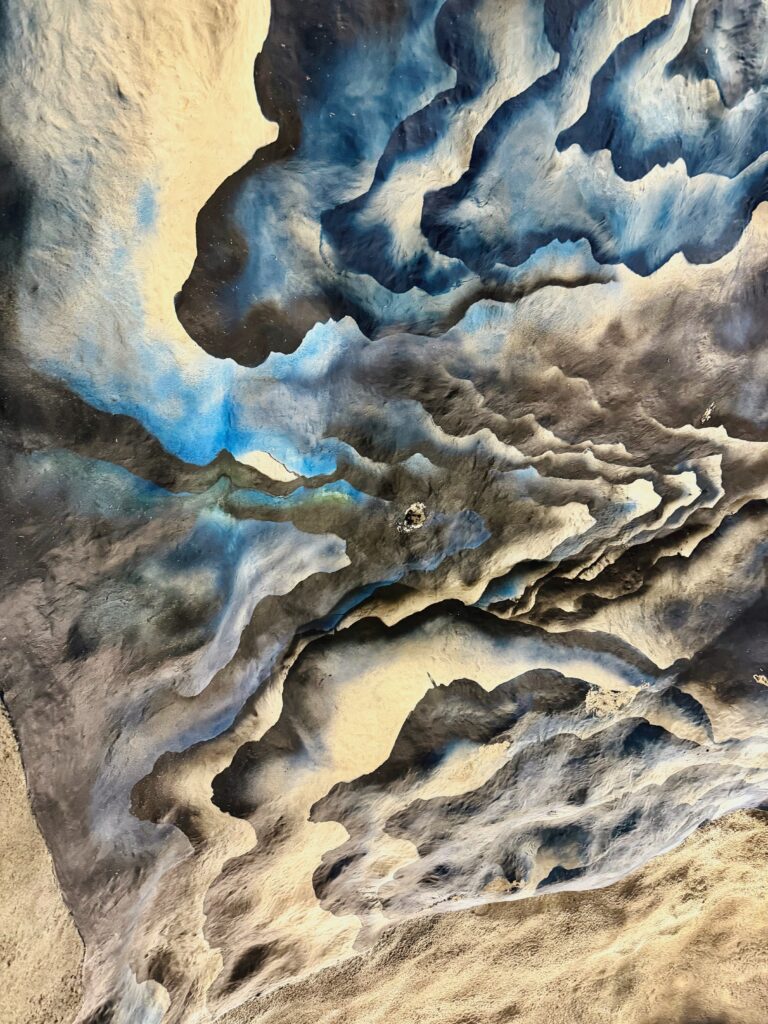
The station sits next to KTH Royal Institute of Technology, and the art is suitably nerdy: fire, water, air and earth, plus technology, the universe and the laws of nature.
Each element is obvious at a glance. Fire gets warm colors and bold shapes, water gets blues, and those two are the most photogenic, red and orange clashing with blue across the rock. For a station named after an engineering school, it feels a bit like elemental magic.
The artist, Lennart Mörk, also hung a dodecahedron for the ether, the ancients’ fifth element that was supposed to fill the universe. I won’t claim I caught every scientific metaphor, but the theme fits the neighborhood perfectly.
Stadion
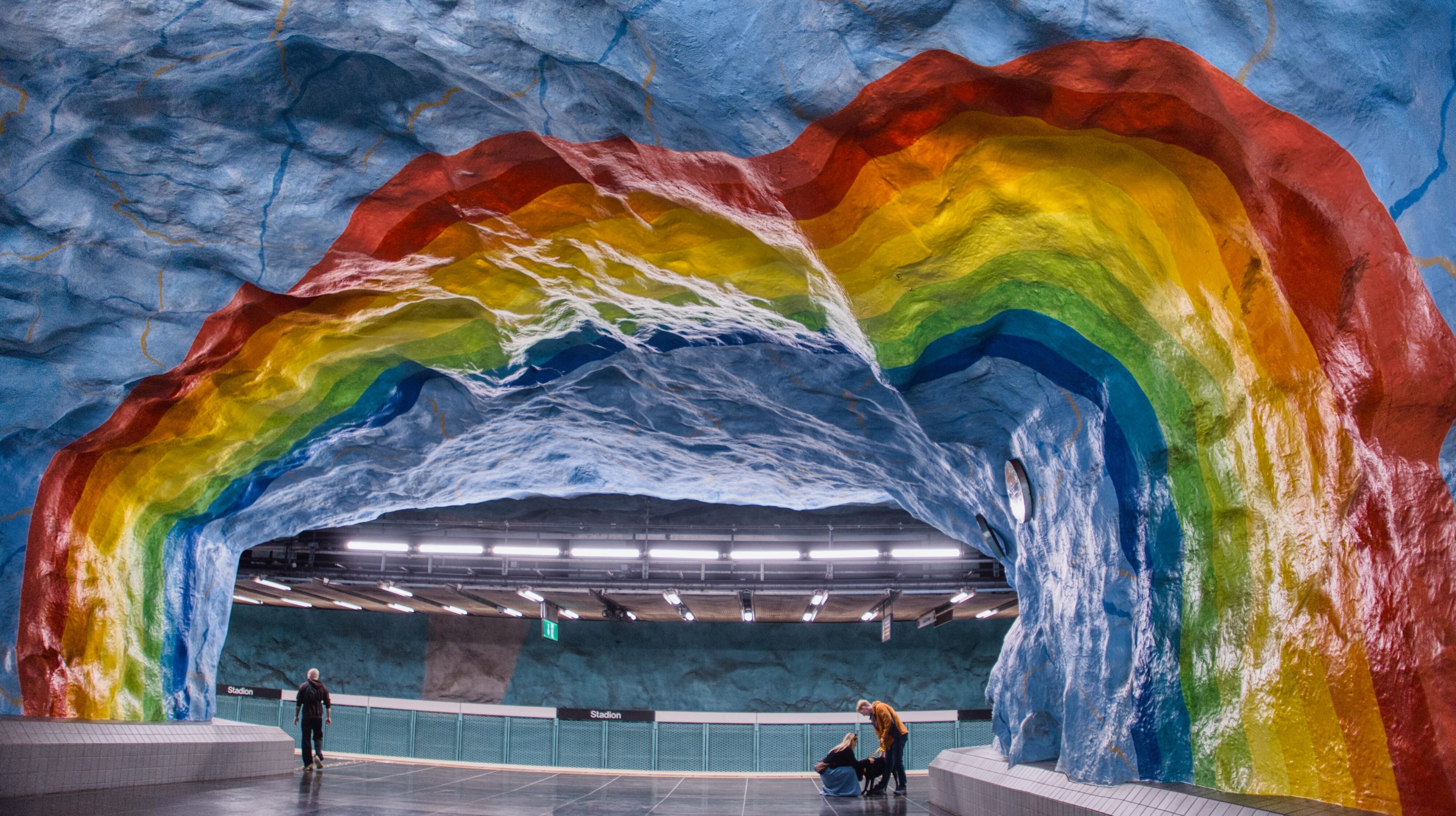
Stadion is famous for its rainbow, but the first thing I fell for was the blue.
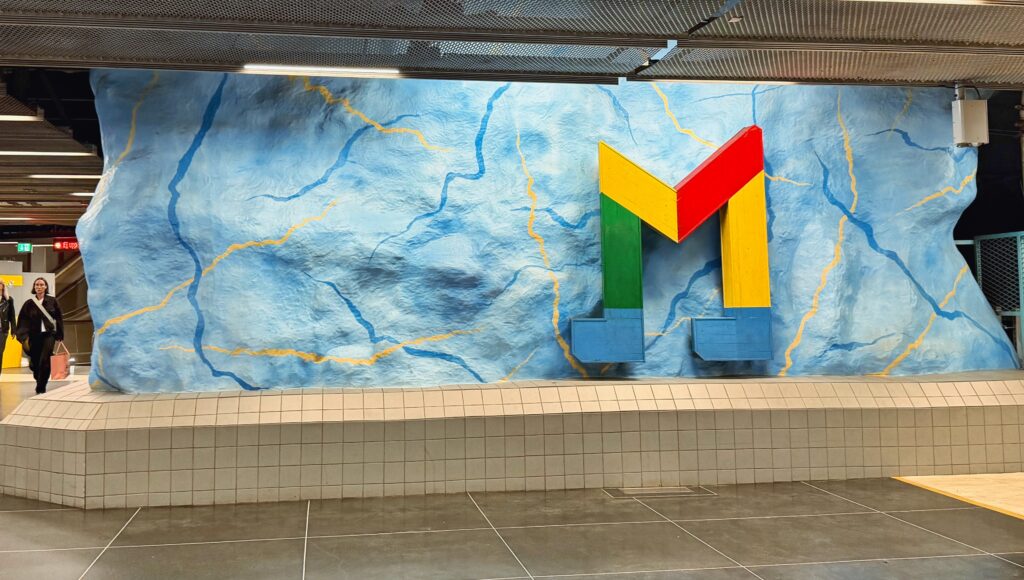
It’s not a cold, industrial blue. The rock walls and ceiling are painted like an open sky. When the station opened in 1973, it was one of Stockholm’s first cave stations, and people worried that riding through bare rock would feel like descending into the underworld. So the artists brought the sky down with them. The guide added the obvious problem: most of the time, Stockholm’s sky is gray.
I understand the artists completely.
Two days earlier, on Sunday, I had seen Stockholm under real sunshine: clean, saturated blue, beautiful enough to make you take the long way around. Days like that don’t come often. This cave pins one in place, so even on a rainy commute you can look up at a sky that won’t disappear.
The rainbow arches over the passage between the two platforms, and naturally my first thought was Pride. The rainbow was originally a nod to the 1912 Stockholm Olympics, held at the stadium next door. But the main Pride festival grounds are right nearby, so these days it greets festival-goers every summer, which seems like a very happy accident.
Then I noticed a giant M on the wall.
My first thought: how did Google get an ad into the Stockholm subway?
It looked so much like the Gmail logo that for a moment I suspected some very rich advertiser had muscled in where it clearly didn’t belong. It turns out the M points toward the music academy nearby, and an S on the other side points to the stadium’s south entrance. Directions, basically. And they were up on that wall a quarter century before Google existed.
That was when it hit me that Google hasn’t been around nearly as long as it feels. Google is everywhere, like air, so when I saw an M that looked like Gmail, I assumed it belonged to Google. We’re just so used to Google that we got the resemblance backwards.
Above and below
Out at sea, the morning was a washout. The islands, the red houses, Fotografiska and the Vasa wreck site were all still there, just pressed flat and gray by the rain.
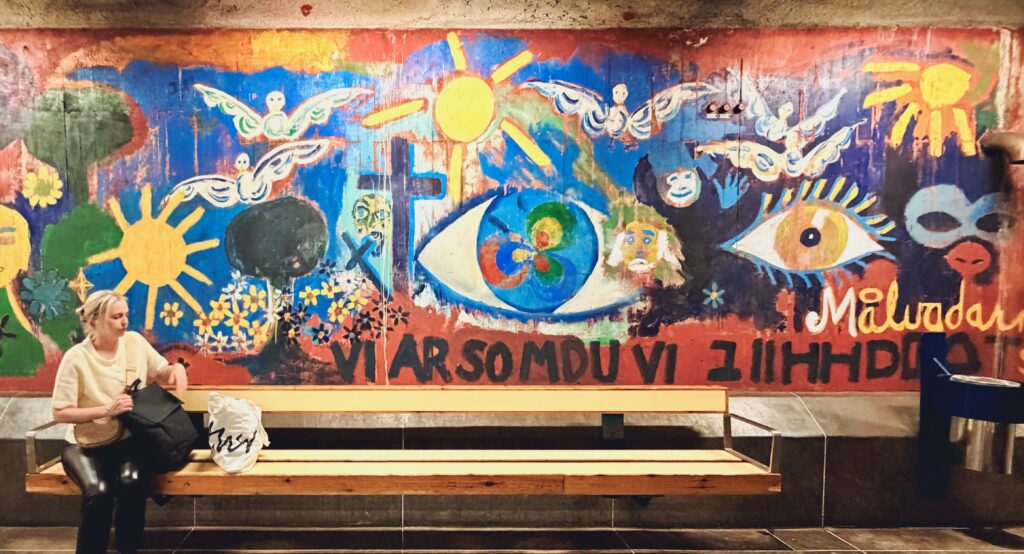
Underground, the weather can’t get in. The rock walls, the rainbow, the two left boots, the tree stump, the dripping water and an M older than Gmail are all kept there on purpose.
In a city made of water, islands and unreliable weather, the view above ground depends on the sky’s cooperation. The rainbow underground is always on.
Leave a Reply